By Anissa Collins, Vice President of Sales & Marketing at Dealer Teamwork
For years, automotive websites have been built around vehicle pricing. Dealers have invested heavily in merchandising inventory, improving vehicle descriptions, and optimizing pricing strategies to attract online shoppers.
But consumer behavior has changed.
Today’s shoppers are increasingly evaluating vehicles based on affordability rather than sticker price. They are searching for monthly payments, lease offers, finance terms, and budget-friendly options long before they submit a lead or step into a showroom.
The challenge for dealerships is that meeting this consumer demand creates a new set of risks. Displaying payment information online can improve engagement and conversion rates, but inaccurate calculations, outdated incentives, or missing disclosures can expose dealerships to significant compliance concerns.
The industry now faces a critical question:
How can dealerships provide the payment transparency consumers expect while maintaining confidence in compliance and operational accuracy?
The Shift from Price-Based Shopping to Payment-Based Shopping
Economic uncertainty, higher interest rates, and evolving consumer expectations have fundamentally changed how customers shop for vehicles. A growing number of buyers no longer begin their journey by asking, “What does this vehicle cost?”
Instead, they ask:
- What will my monthly payment be?
- Can I afford this vehicle?
- What are my lease options?
- How much money is due at signing?
These questions are driving search behavior across Google, vehicle marketplaces, and dealership websites.
Dealers that fail to answer these questions online often create friction in the shopping process. Consumers are forced to leave the website, perform their own calculations, or continue their search elsewhere. The result is lost engagement, lower conversion rates, and missed opportunities with highly motivated shoppers.
The Compliance Challenge
While displaying payment estimates may seem straightforward, maintaining compliant and accurate payment information across hundreds or thousands of vehicles is anything but simple.
Inventory changes daily. Incentives change monthly. Interest rates fluctuate. Regional regulations vary. Disclosures must remain accurate.
Many dealerships still rely on manual processes or static payment calculators that cannot keep pace with these changes. This creates significant operational burdens and increases the likelihood of displaying outdated or inaccurate information.
For dealer principals, GMs, and marketing leaders, the risk extends beyond lost conversions. Compliance issues can create reputational damage, regulatory scrutiny, and unnecessary liability. The reality is that modern payment merchandising requires both marketing intelligence and compliance discipline.
Why Automation Has Become Essential
The complexity of managing inventory-level payment information manually has made automation a necessity rather than a luxury. Advanced technology platforms now enable dealerships to dynamically generate payment estimates across inventory pages while incorporating current incentives, finance programs, and required disclosures.
The benefits are significant:
- Consistent payment visibility across inventory
- Reduced manual workload for dealership staff
- Improved shopper engagement
- Enhanced lead conversion opportunities
- Greater confidence in compliance processes
More importantly, automation allows dealerships to scale payment merchandising across their entire inventory without creating additional operational complexity.
What to Look for in a Vendor: Balancing Payment Transparency and Compliance
As payment-based shopping becomes more important, dealerships need solutions that support both a strong customer experience and compliance requirements. The right partner should make it easier to deliver accurate payment information without adding operational complexity.
When evaluating vendors, look for solutions that:
- Display payments throughout the shopping journey, not just in a calculator
- Automatically incorporate current incentives, rebates, taxes, and fees
- Update payment information across inventory in real time
- Maintain consistency between advertising, website, and digital retailing tools
- Support compliance with clear, accurate disclosures
- Reduce manual processes through automation
The best solutions help dealerships provide trustworthy affordability information while improving operational efficiency and confidence in payment accuracy.
The Future of Automotive Advertising
Digital advertising continues to evolve, but one trend is becoming increasingly clear: Consumers expect transparency. They want payment information earlier in the buying process. They want answers immediately. And they expect those answers to be accurate.
Dealerships that can meet these expectations while effectively managing compliance requirements will be better positioned to capture market share, increase lead volume, and improve customer trust.
The next generation of automotive marketing will not be defined solely by inventory visibility or pricing strategy. It will be defined by a dealership’s ability to connect shopper intent with accurate, compliant, and personalized payment information at every stage of the digital journey. For forward-thinking dealers, that future is already here, and advanced automation is making it possible.
Ready to Modernize Your Payment Strategy?
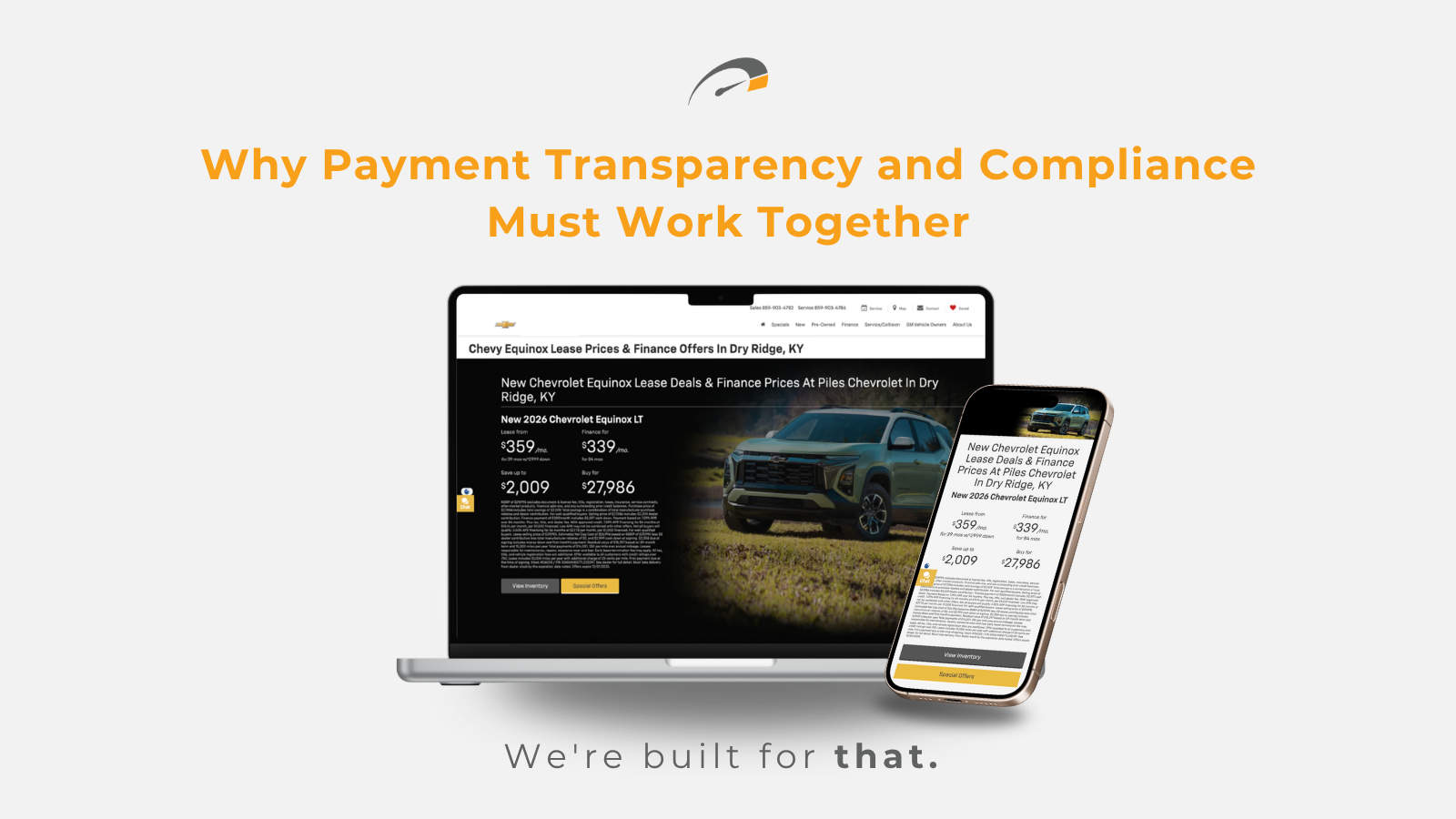
At Dealer Teamwork, we help dealerships deliver the payment transparency today’s shoppers expect without sacrificing compliance or creating additional manual work. Our patented MPOP® and IPOP™ platforms automatically transform live inventory, incentives, pricing, and payment data into accurate, compliant offers across search, social, landing pages, and every Vehicle Detail Page (VDP). The result is a more consistent shopping experience, greater operational efficiency, and more opportunities to convert high-intent shoppers.
Contact Dealer Teamwork to learn how automated payment merchandising can help your dealership build trust, improve performance, and stay ahead of the future of digital advertising.