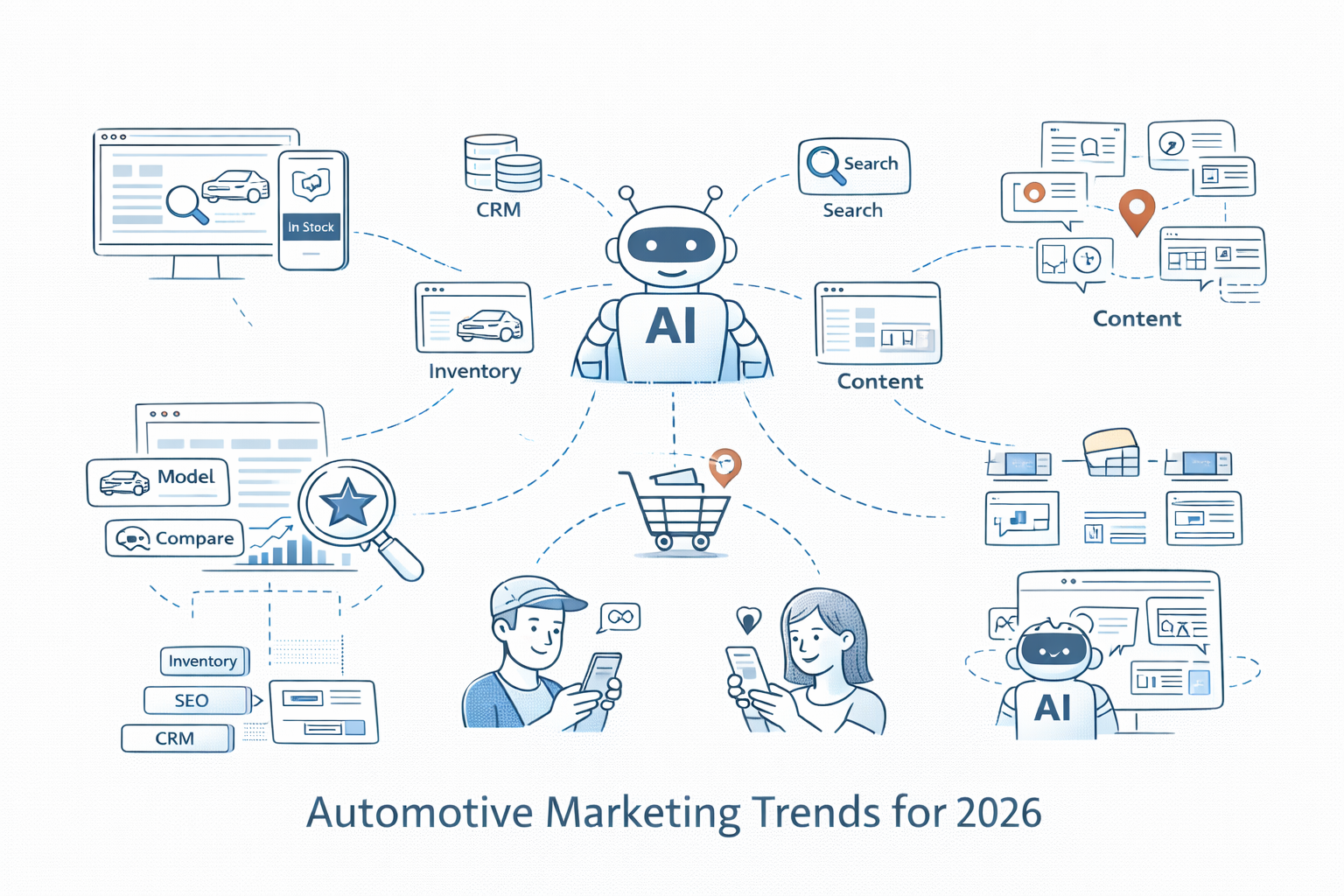
It’s been a few years since my last automotive marketing predictions article. Why? There hasn’t been anything exciting enough that grabbed everyone’s attention the way AI has recently.
Everyone can feel it now. AI is the King of Buzz now.
With another year in the books, I felt that another wave of “what’s next” conversations needed to be addressed. This is an excellent opportunity for everyone to understand what’s happening with AI. Plus, we’re always curious about the future of this business we obsess over daily.
The last few years forced us to re-learn a great deal. Automotive marketing doesn’t move in clean, predictable cycles. Inventory swings faster. Consumer behavior shifts quicker. Search changes quietly, then all at once. And AI is no longer theoretical; it is operational.
Here are my seven (and a half) automotive marketing predictions for 2026. These trends will have a significant and lasting impact that extends well beyond this year.
1. Inventory and Pricing Reality Will Reshape Search Demand
Incentives are back, and margins are under pressure. That combination alone changes how consumers search. Especially with the ability for shoppers to rely on AI overviews. Shoppers are no longer just looking for “best SUV” or “top safety ratings.” They are searching for availability, price movement, rebates, and proof that a deal is real.
Search behavior will increasingly reflect pricing sensitivity and immediacy. Queries will trend toward trim-level detail, payment context, and “in stock now” signals. Dealers that fail to keep inventory feeds, pricing, and incentive messaging tightly aligned across SEO, paid search, and VDPs will lose trust fast.
Prediction: Dealers who prioritize pricing accuracy, competitive market pricing factors, and inventory payments transparency as a search strategy will outperform those relying solely on generic model-level traffic from a classic paid search campaign.
2. AI Stops Being a Buzzword and Becomes Core Infrastructure
AI chatter exploded in 2025. Just ask Brent Wees, he knows what’s happening in the AI ecosystem (And what isn’t). Real impact lagged behind the hype. In 2026, that gap closes even more.
AI will move deeper into CRM workflows, lead handling, personalization, and content operations. This won’t be flashy overlays, but systems that actually reduce response time, improve consistency, and remove repetitive work from teams.
The biggest mistake dealers will make is adopting disconnected AI tools that sit outside core systems. The biggest wins will come from AI that lives inside inventory, CRM, and marketing platforms where real decisions happen.
Prediction: Dealers that integrate AI into existing workflows will gain efficiency and consistency. Dealers that bolt it on to already broken operations will create more noise than value.
3. Organic Search Becomes the Foundation Again
Paid search campaigns will always matter, but organic search is reasserting itself as the most durable traffic source dealers have. Not because rankings are easy, but because content authority compounds.
In 2026, automotive SEO success will come from structured content ecosystems, not just individual pages. Model hubs, comparison pages, body-style clusters, service education, internal linking, and schema will matter more than chasing individual keywords.
UX signals will continue to rise in importance. Organic contribution values, Conversion/Engagement rates, and AI Visibility/Share of Voice will matter more than word count, keyword density, and total backlinks, or any other archaic vanity metric.
Prediction: Dealers who invest in content that genuinely helps shoppers make decisions will win long after short-term campaigns fade.
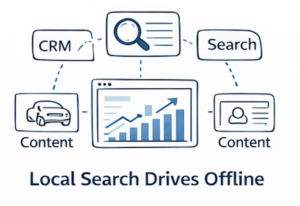
4. Local Search Drives More Offline Conversions Than Any Other Channel
Local search continues to be underappreciated and underestimated. That won’t last much longer.
Google Business Profiles, map visibility, the hidden power of reviews and responses, photos, localized inventory pages, and service content all directly influence foot traffic and phone calls.
As search engines get better at understanding local intent, sloppy local execution becomes more expensive. How does it become more expensive? By causing dealers to spend even more on paid search to fill the visibility gaps.
Prediction: Dealers who treat local SEO as a primary revenue channel, rather than a checklist item, will capture higher-quality traffic closer to the sale.
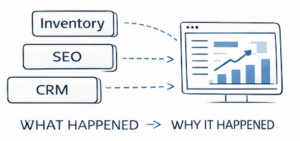
5. Infinite Context Finally Breaks Siloed Marketing
Dealership marketing has always been fragmented. Inventory here. Pricing there. Paid Search is its own island. SEO in one tool. CRM in another. Performance reviews are once a month.
Infinite context changes that.
In 2026, dealership systems and vendor platforms will increasingly operate with continuous awareness of inventory history, pricing changes, incentives, search behavior, engagement data, and outcomes. Instead of asking “what happened,” systems will reason through why it happened.
Prediction: Dealers who connect data into a single operating context will make faster, smarter decisions than those still managing channels in isolation.
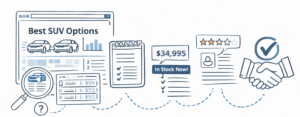
6. Chain-of-Thought Reasoning Changes Content Strategy
Buyers do not make one decision. They make many small ones in sequence.
Chain-of-thought reasoning mirrors how shoppers actually behave. Compare options. Narrow choices. Validate pricing. Confirm trust. Then act. Content and campaigns must reflect that reality. Comparison pages, FAQs, internal links, and structured data become decision tools, not filler.
Want to see Chain-of-Thought in action? Try a transactional intent-based search in ChatGPT or an AI-based browser such as Atlas, Comet, or Co-Pilot. The systems will eventually have the ability to connect every step of the shopping, buying, and ownership stages that a buyer needs to know. (Want to learn even more about Agentic AI? Follow Bill Playford, he also knows what’s up here.)
Prediction: Dealers who build content to support multi-step buyer journeys will attract higher-intent traffic, even as AI-related search volumes become less predictable or reliable.
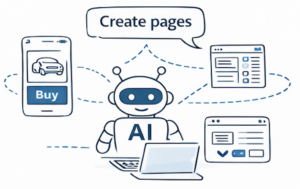
7. Agents and Text-to-Action Replace Manual Marketing Work
This will be among the biggest shifts to happen among automotive marketing predictions and trends.
In 2026, the most efficient vendors and marketing teams will stop clicking buttons all day. Agents will monitor inventory, track trends, identify pricing shifts, and analyze performance signals. Humans will give instructions. Systems will execute.
- “Create pages for our fastest-growing used models.”
- “Update metadata where CTR dropped.”
- “Flag pages that lost indexing.”
- “Publish drafts and notify QA.”
Prediction: Dealers that adopt agent-driven execution will move faster, make fewer mistakes, and lower operational costs while keeping humans focused on strategy and oversight.

7.5. Social Commerce Rockets to New Levels
Social commerce is expected to grow as shoppers continue to purchase products directly within social media apps, such as TikTok Shop and Instagram Checkout. This is a major trend and will transform social platforms into digital marketplaces with less friction.
Prediction: Keep your eyes open for new ways dealers explore solutions for retail and even fixed operations. These social commerce solutions will help dealers connect their brands with younger audiences in ways never experienced before.
The Risk of Standing Still in 2026
None of these changes is science fiction. They’re already happening, just unevenly. Each of these automotive marketing predictions comes with an upside. They also come with a very real downside if ignored.
- Dealers who don’t align inventory, pricing, and search visibility will continue to see traffic that looks fine on paper but fails to convert. Shoppers will click, compare, and leave because the experience does not match the promise. That gap will get more expensive as competition tightens and margins stay under pressure.
- Ignoring AI as core infrastructure rather than a novelty will quietly put teams at a disadvantage. Not because AI replaces people, but because it replaces delay. Dealers who still rely on manual workflows will move slower, respond later, and struggle to scale consistency as demand shifts week to week.
- Dealers who underinvest in organic search and content authority will become more dependent on paid traffic at the exact moment paid efficiency becomes harder to maintain. When budgets tighten, the lack of a strong organic foundation shows up fast, and recovery is slow.
- A disconnected digital and in-store experience can break shoppers’ trust, even when pricing is competitive. Shoppers will increasingly choose the dealer who feels easier to do business with, not just the one who looks cheapest in a search result.
- Local search neglect is another silent risk. Poor profiles, weak reviews, outdated photos, and thin local content may not always be seen in reports immediately. It’ll show up later as fewer phone calls, fewer walk-ins, and fewer repeat customers.
- The biggest long-term risk, though, is staying siloed. Dealers who cannot connect inventory, pricing, search behavior, and outcomes into a single operating view will always be reacting instead of anticipating. As agents, reasoning systems, and text-to-action workflows mature, the gap between fast and slow operators will widen quickly.
Early adopters don’t win because they chase trends. They win because they reduce friction sooner, learn faster, and build systems that adapt. 2026 will reward dealers who move with intention and punish those who wait for certainty. The window to experiment, connect systems, and modernize execution is open now. It won’t stay open long.
This year is about connection. Connected data. Connected experiences. Connected decision-making. Even Agents are connected to other Agents.
What are the other automotive marketing predictions or trends that you see reshaping the way marketing systems execute?
Happy New Year to everyone, and I wish you all a successful 2026!